The real job of governing-body media – and why stronger official coverage need not come at the expense of independent journalism.
Here’s a fairly obvious statement: official coverage is not independent journalism. Nor should anyone pretend it is.
But from that, a much shakier conclusion sometimes follows: that the more governing bodies publish, the more they squeeze out independent media.
I don’t buy that.
A federation covering its own event is not the same thing as a federation trying to replace journalists. And in athletics, much of what can look from the outside like a huge governing-body media operation is actually there to help external media do their jobs.
That distinction matters.
What official coverage is actually for
A governing body staging a major competition has a basic responsibility to tell people what is happening.
There needs to be accurate information before the event. There needs to be a record afterwards of who won, what they achieved and why it mattered. Results, statistics, entry information and historical context need somewhere authoritative to live.
At World Athletics, much of the website coverage around major championships exists for exactly that reason.
Previews are read by fans, of course, but they are also a resource for journalists, commentators and broadcasters. They bring together form, statistics, previous performances, championship history and the significant storylines in one place.
Reports perform an even simpler function. They create an authoritative contemporaneous record of what happened.
And, interestingly, while some critics think governing bodies already produce too much, plenty of journalists expect more.
At this year’s Diamond League meeting in Zurich, after Alison dos Santos broke the world record, one journalist began asking our team almost immediately: “When’s the flash report coming out?!”
It was a small moment, but quite a revealing one.
For all the talk of governing-body coverage crowding out independent media, the media themselves routinely rely on that same coverage as a resource. Sometimes they actively expect it to be there.
A race report saying who won the men’s 1500m, how the race unfolded and what time they ran does not prevent an independent outlet from analysing the tactics, interviewing the protagonists, questioning selection decisions, examining wider issues or deciding that the most interesting story was somebody who finished sixth.
They are different products serving different purposes.
Helping the sport grow
There is another reason governing bodies produce year-round content that tends to get overlooked in this debate: governing bodies are trying to grow the sport.
Governing bodies have strategic objectives around attracting fans, increasing engagement, encouraging participation and strengthening the foundations of the sport at every level. Communicating what happens in athletics, telling athletes’ stories and making the sport easier to follow are all part of achieving those goals.
That is not the same thing as trying to put independent publishers out of business.
Think about how most sports fans begin. Very few of us became interested because we stumbled across an organisational strategy document. We watched somebody extraordinary do something extraordinary.
An athlete, a race, a rivalry or a championship captured our imagination. From there we watched more, learned more and, in many cases, became participants, volunteers, coaches, officials or lifelong fans. That pipeline matters.
If better storytelling helps somebody discover athletics, understand it and care about it, that ultimately benefits the whole sport – including the independent media whose audience depends on there being people interested enough to read about it.
Official coverage is therefore doing several jobs at once: informing existing fans, creating a historical record, supporting the media and trying to create new fans.
None of those objectives requires independent journalism to disappear.
What a major-event media operation actually looks like
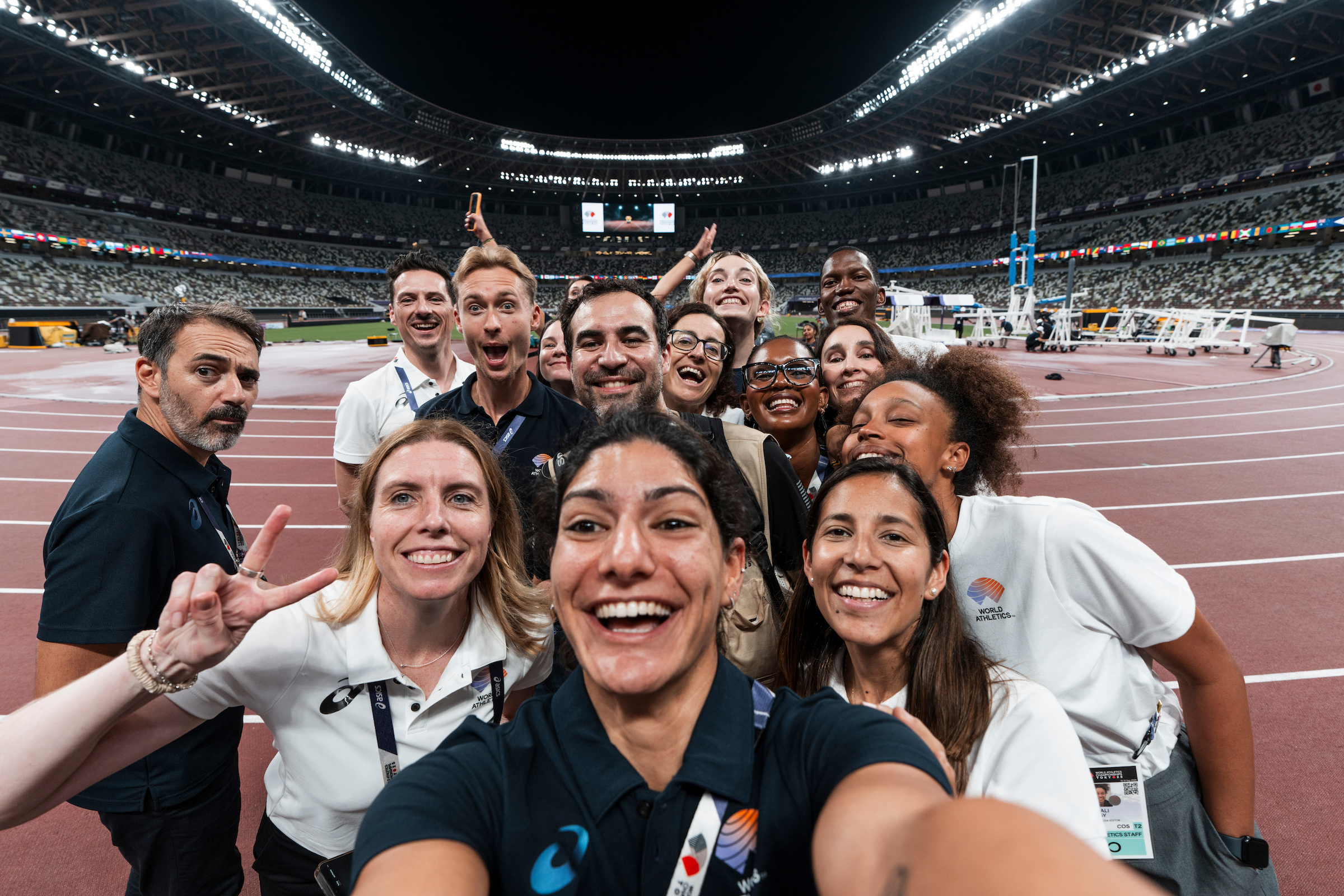
Major championships involve a lot of people working in media-related roles. But only a small proportion of them are actually producing content for the governing body’s own channels. Many more are there to help external media cover the event.
Take the inaugural World Athletics Ultimate Championship in Budapest. World Athletics had about 80 people on the ground, spanning a whole range of functional areas. Four of them, just 5% of that contingent, were populating the federation’s main website and social channels. Another three worked on the dedicated Ultimate channels.
So among 337 accredited media at the championship, seven people, roughly 2%, were producing content for World Athletics platforms.
Separately, 11 World Athletics staff were working across media operations, PR and communications. Their role was overwhelmingly to help the international media do their jobs.
Then there were photographers and photo editors supplying imagery, teams collecting flash quotes, staff arranging athlete access, servicing media requests, preparing information and trying to ensure hundreds of journalists and broadcasters could get what they needed.
Much of what can look from the outside like a giant content operation is actually a media-service operation.
Access does not create journalism. Journalists do.
Perhaps the clearest example was The Day Before, a new pre-championship media event in Budapest.
Months of work went into bringing about 200 athletes together and making them accessible to more than 200 accredited journalists and broadcasters.
That level of access is extraordinarily difficult to create. But access itself is only the starting point.
A governing body can bring the athletes into the room. It can create interview opportunities, make photographers available, provide statistics and background information and give journalists time to ask questions.
What it cannot do is decide what an independent journalist makes of that opportunity. That is where the distinction becomes important.
If governing bodies are giving journalists greater access, better data, extensive imagery and more source material than ever before, what is independent media doing with the opportunity? That is not a rhetorical attack on independent journalism. It is, I think, the more useful question.
The answer to increasingly sophisticated official coverage surely cannot be for governing bodies to make their own coverage worse. It is for independent media to concentrate on the things official channels cannot properly provide.
Scrutiny. Investigation. Challenge. Opinion. Independent analysis. Difficult questions. Unexpected angles. Reporting that follows the story rather than an institutional communications objective.
Those are not weaknesses in governing-body media. They are the reason independent journalism remains essential.
It is more interdependent than adversarial
The relationship between governing bodies and independent media is also considerably less binary than it is sometimes presented.
Independent outlets routinely benefit from supplied photography, statistics, media information, mixed-zone facilities, interview opportunities and other services provided by event organisers. These relationships can also include travel support, content partnerships and paid promotional work alongside genuinely independent editorial coverage.
None of that compromises an outlet’s right to criticise a governing body, and nor should it. But it does illustrate that this is not simply a battle between two competing newsrooms fighting for the same audience. The relationship is often symbiotic.
Governing bodies want strong independent coverage because it gives the sport reach, credibility and perspectives that official platforms cannot provide. Independent media benefit from governing bodies investing heavily in the infrastructure that makes covering major sport possible.
Both sides should be capable of acknowledging that.
Where governing-body coverage can go wrong
None of this means official media should be beyond criticism. It can become too promotional. The line between editorial information and marketing can become blurred. Mistakes happen. Institutional interests inevitably create blind spots.
Official channels should be clear about what they are. And if a governing body’s own actions are the story, its website will never be a substitute for genuinely independent reporting. That is precisely why a healthy sport needs both.
The governing body provides the official record, information, access and much of the infrastructure. Independent media provide the distance. One should not be expected to perform the other’s job.
Raise the bar, don’t lower it
Sport has changed enormously since governing bodies relied almost entirely on newspapers and broadcasters to tell their stories. Federations can now communicate directly with millions of people. That is not going away.
Trying to preserve independent journalism by asking official channels to produce less content feels like solving the wrong problem. If a federation publishes a factual preview, an independent publication should be capable of producing something different. If an official website reports who won, the independent journalist has licence to explain why it mattered.
And if a governing body puts hundreds of athletes in front of the media, creates the access, supplies the imagery and provides the background information, the opportunity exists to produce journalism that no official platform could or should replicate.
That is the space independent media should own.
The answer to stronger governing-body media isn’t weaker governing-body media. It’s stronger independent journalism.
Views expressed here are my own and do not necessarily represent those of any employer.